
 Continue With Google
 continue with facebook




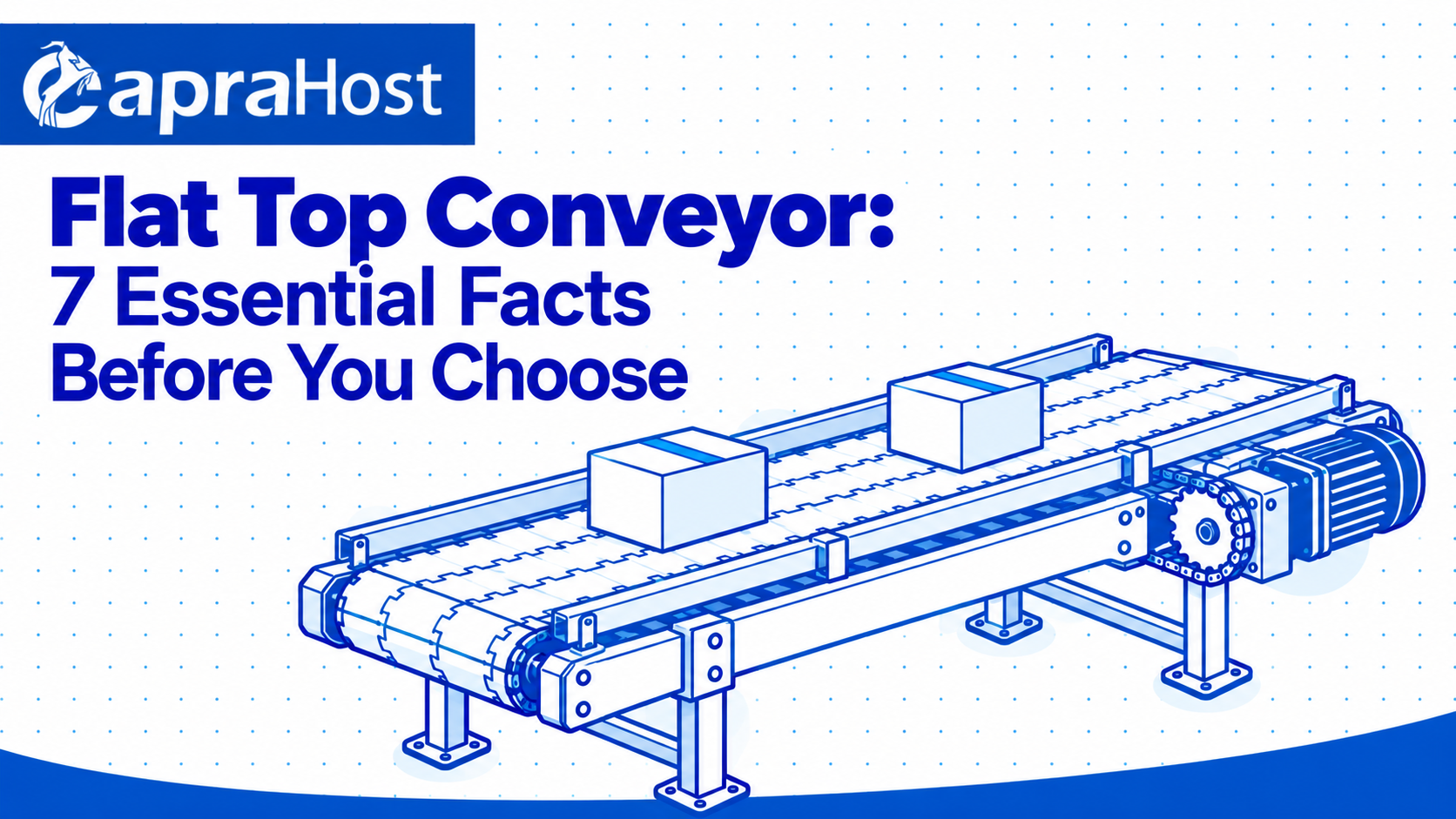
A flat top conveyor is a material handling system that moves products smoothly through production lines. It uses connected chain links to create a flat, moving surface. This design helps transport bottles, cans, cartons, and other containers between manufacturing stages.
Flat top conveyors are widely used in food processing, packaging, pharmaceuticals, and industrial assembly. They come in different materials and configurations, including plastic, stainless steel, and side-flexing chains. Choosing the right conveyor depends on product size, weight, operating speed, and available space.
This guide explains seven essential facts about flat top conveyors before you choose one. You’ll learn how they work, their components, types, applications, advantages, and limitations. You’ll also discover how to compare conveyor systems, understand specifications, and manage maintenance costs.
What Is a Flat Top Conveyor?
A flat top conveyor is a chain-driven system designed to move products across a flat, continuous conveying surface. Its connected links travel around sprockets powered by an electric motor. The surface supports products like bottles, cans, jars, and small packages during transport.
The main purpose is to move products between production stages without repeated manual handling. For example, a bottling line may connect filling, capping, and labeling machines. Guide rails can keep containers aligned while the moving chain carries them forward.
A tabletop chain conveyor generally refers to the same equipment as a flat top chain conveyor. Both terms describe linked chain plates forming a flat carrying surface. However, a modular belt conveyor uses a different belt structure, often designed for wider conveying surfaces.
How Does a Flat Top Conveyor Work?
A flat top conveyor works by using a motor-driven chain to transport products along a fixed path. The motor rotates a drive sprocket, which engages the connected chain links. This movement creates a continuous carrying surface for products.
The working process follows five steps:
- Motor activation: An electric motor supplies power to the conveyor drive system. A gearbox adjusts rotational speed and provides the required torque. The drive transfers this movement to the conveyor shaft.
- Sprocket rotation: The drive sprocket engages the chain’s connecting structure. Its rotation pulls the linked chain along the conveyor frame. Compatible sprocket teeth and chain pitch are essential for reliable movement.
- Chain movement: The chain slides across supporting wear strips along the carrying path. These strips provide support and help protect the conveyor frame. Their material and condition influence friction and chain wear.
- Product transportation: The moving surface carries products like bottles, cans, and cartons. Guide rails help maintain alignment during straight or curved movement. Transfer sections allow products to pass between connected equipment.
- Chain return: At the discharge end, the chain travels around the return path. It moves underneath the conveyor toward the drive or return section. The process repeats continuously while the conveyor operates.
Conveyor speed must match the needs of connected production equipment. Excessive speed can increase product instability, especially near curves and transfer points. Suitable spacing, guide positioning, and speed control support consistent product flow.
Main Components of a Flat Top Conveyor
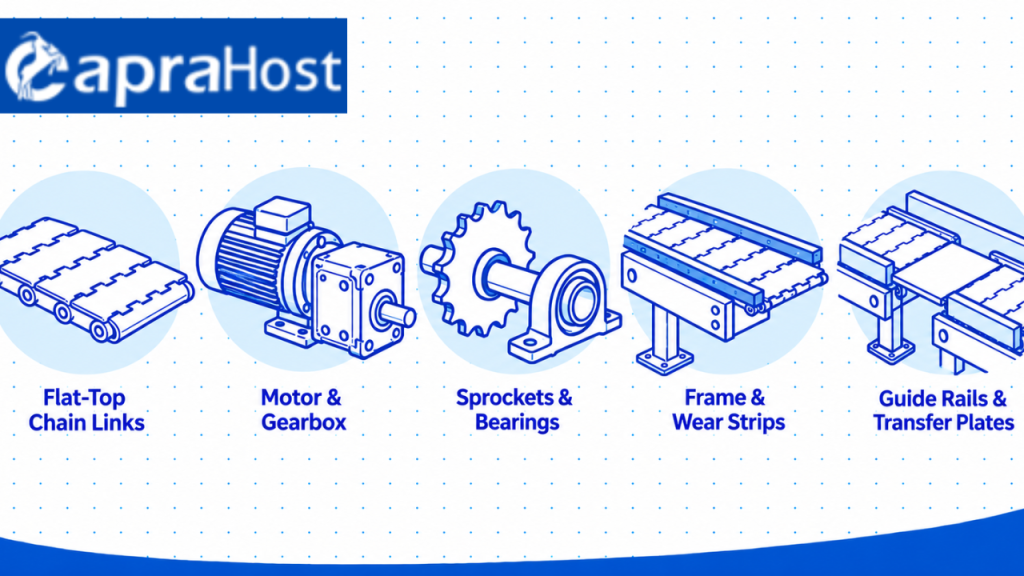
A flat top conveyor has five main component groups that support movement, stability, and mechanical operation. Each group performs a specific function during transportation. Understanding these components helps with equipment selection and maintenance.
- Flat Top Chain Links: Connected plastic or metal links form the conveyor’s moving surface. They carry products like bottles, cans, and cartons along the conveying path. Chain width, pitch, and material influence product support and operating suitability.
- Drive Motor and Gearbox: The motor supplies power for continuous chain movement. The gearbox reduces motor speed and increases available torque. Together, they help maintain the required conveyor operating speed.
- Sprockets and Bearings: Drive sprockets engage the chain and transfer rotational movement. Bearings support rotating shafts and allow controlled shaft rotation. Worn sprockets or damaged bearings can affect conveyor operation.
- Conveyor Frame and Wear Strips: The frame supports the conveyor’s mechanical structure and carrying path. Wear strips create a sliding surface beneath the chain. Proper alignment helps distribute contact and reduce unnecessary wear.
- Guide Rails and Transfer Plates: Guide rails control the position of moving products. Transfer plates help containers cross gaps between conveyor sections. Correct positioning reduces the risk of tipping, catching, and product jams.
Types of Flat Top Conveyors
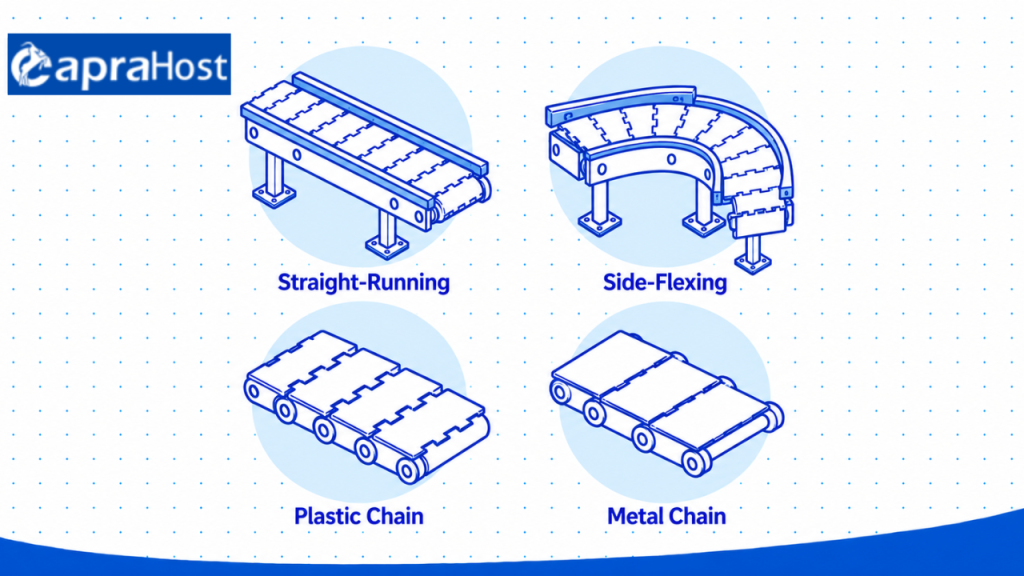
Flat top conveyors can be classified by conveying direction and chain material. Four important categories are straight-running, side-flexing, plastic, and metal chain conveyors. These categories overlap because direction and material describe different design characteristics.
Straight-Running Flat Top Chain Conveyors
Straight-running flat top conveyors transport products along a straight conveying path. They use linked chain plates to support products like bottles, jars, and cartons. Their design suits production lines connecting equipment in a direct arrangement.
These conveyors are commonly used between filling, inspection, and packaging stations. They can operate with suitable plastic or metal chains. Straight layouts usually avoid the additional curve requirements of side-flexing designs.
Side-Flexing Flat Top Chain Conveyors
Side-flexing conveyors use specially designed chains that can move around horizontal curves. They support layouts such as L-shaped and U-shaped conveying paths. This flexibility helps connect production equipment when factory space is limited.
The minimum curve radius depends on the selected chain and conveyor construction. Tight curves can increase chain forces and friction. Always check the manufacturer’s curve specifications before designing the layout.
Plastic Flat Top Chain Conveyors
Plastic flat top conveyors use polymer chain links to transport products along a continuous surface. Common materials include acetal, also called POM, and polypropylene. These materials offer different friction, chemical resistance, and temperature characteristics.
Plastic chains are frequently used in bottling and packaging applications. Their suitability depends on the product load and operating environment. Wet conditions also require compatible wear strips, cleaning chemicals, and supporting components.
Stainless Steel and Carbon Steel Flat Top Chain Conveyors
Metal flat top conveyors use steel chain plates for industrial conveying applications. Stainless steel generally offers better corrosion resistance than unprotected carbon steel. Carbon steel can be appropriate for suitable dry environments and mechanical loading requirements.
Metal chain selection also depends on temperature, product weight, and cleaning procedures. Stainless steel may suit wet processing areas requiring regular washdown. However, every material must be checked against the actual operating conditions.
Common Applications of Flat Top Conveyors
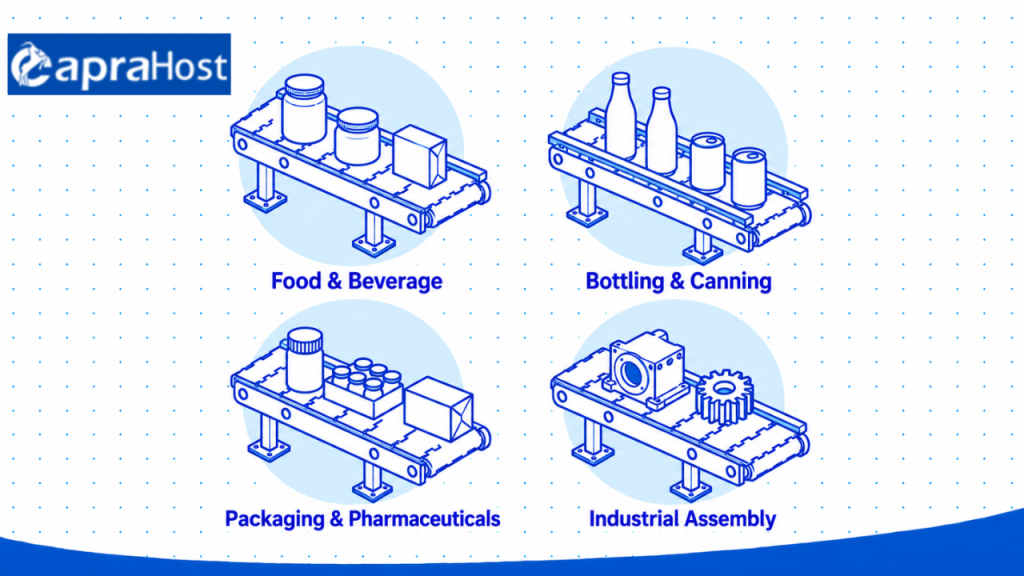
Flat top conveyors are used in food processing, bottling, packaging, pharmaceuticals, and industrial manufacturing. Their main role is to move supported products between connected production operations. The correct chain type depends on product characteristics and environmental requirements.
1. Food and Beverage Processing
Food production lines use suitable flat top conveyors to transport sealed containers and packaged products. Examples include beverage bottles, food jars, and packaged snacks. Chain material and conveyor construction must match the facility’s hygiene and cleaning requirements.
2. Bottling and Canning Lines
Bottling and canning lines transport containers between filling, capping, labeling, and inspection equipment. The flat surface supports upright products like glass bottles, plastic bottles, and metal cans. Proper guide rails and transfer design help reduce tipping during movement.
3. Packaging and Pharmaceutical Production
Packaging conveyors move products like cartons, trays, and sealed containers between machines. Pharmaceutical applications may involve medicine bottles, packaged vials, and finished cartons. Materials, cleaning methods, and equipment design must meet the relevant production requirements.
4. Automotive and Industrial Assembly
Industrial assembly lines can use suitable flat top conveyors to transport manufactured components. Examples include plastic housings, mechanical parts, and metal assemblies. Heavy or unusually shaped products require appropriate support, load ratings, and conveyor design.
Advantages and Limitations of Flat Top Conveyors
Flat top conveyors offer stable product support and flexible conveying options, but they also have operating limitations. Their suitability depends on chain construction, load, speed, and product characteristics. Understanding these trade-offs prevents incorrect equipment selection.
Key Advantages
- Stable Product Movement: A flat chain surface supports upright products during transport. Bottles, cans, and jars can move between production stations with suitable guidance. Correct transfer design further reduces product instability.
- Flexible Conveyor Layouts: Side-flexing chains allow suitable conveyors to follow horizontal curves. This supports production layouts where straight paths are impractical. Some engineered systems also accommodate elevation changes.
- Continuous Transport and Accumulation: Flat top chains provide continuous movement between processing machines. Suitable systems can allow products to accumulate temporarily before downstream equipment. Accumulation pressure and product friction still require careful control.
- Replaceable Chain Components: Certain conveyor designs allow individual damaged links to be replaced. This can reduce the need to replace an entire chain assembly. Replacement must follow the manufacturer’s compatibility and maintenance instructions.
Common Limitations
- Chain Wear and Friction: Sliding contact between the chain and wear strips produces friction. Incorrect alignment, unsuitable materials, and excessive loading can increase wear. Routine inspection helps identify developing problems.
- Load and Layout Restrictions: Every conveyor has operating limits based on its specific construction. Chain pull, product weight, curve radius, and speed affect allowable performance. A design suitable for bottles may not support heavy metal components.
- Maintenance Requirements: Chain links, sprockets, bearings, and guide rails require periodic inspection. Debris, damaged components, or unsuitable adjustments can interrupt production. Maintenance access should therefore influence conveyor selection.
Flat Top Conveyor vs Other Conveyor Systems
Flat top conveyors differ from belt, modular belt, and roller conveyors in construction and product handling. Each design supports different operational requirements. The right choice depends on product shape, load, conveying path, and available space.
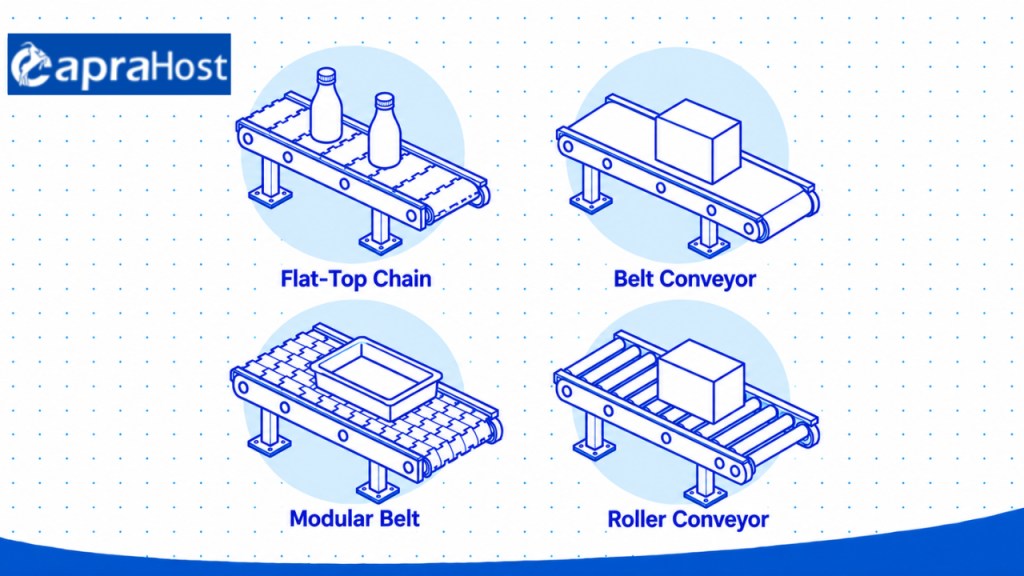
Flat Top Conveyor vs Belt Conveyor
Flat top chain conveyors use connected links, while conventional belt conveyors use a continuous flexible belt. Flat top chains commonly transport upright containers like bottles and cans. Belt conveyors can carry products like cartons, parcels, and loose materials when appropriately designed.
Side-flexing flat top chains can travel through suitable horizontal curves. Conventional straight belt conveyors generally require special designs or transfers to change direction. Neither technology is automatically better for every application.
Flat Top Chain vs Modular Belt Conveyor
Flat top chains typically provide relatively narrow conveying tracks, while modular belts can create much wider surfaces. Both use interconnected elements, but their construction and available configurations differ. Flat top chains commonly handle bottles, while modular belts also accommodate broader packaged products.
Modular belts can be selected for applications requiring wider conveying surfaces. Flat top chains may suit compact single-file container handling. Product support, cleaning requirements, and layout determine the better option.
Flat Top Conveyor vs Roller Conveyor
Flat top conveyors provide a continuous carrying surface, while roller conveyors support products on rotating rollers. Flat top chains suit containers like bottles and cans with relatively small bases. Roller conveyors commonly handle rigid-bottomed products like boxes, cartons, and pallets.
Roller conveyors may operate through gravity or powered rollers. Flat top chain conveyors rely on a driven chain surface. The product base, weight, and movement requirements determine which design is appropriate.
Flat Top Conveyor Sizes and Specifications
Flat top conveyor specifications include width, length, chain pitch, load capacity, operating speed, and curve radius. Each measurement affects conveyor suitability. Manufacturer specifications must be checked for the exact model and configuration.
- Conveyor Width and Length: Chain width influences how products are supported during movement. Conveyor length determines the distance the system can connect between production stations. For example, mk North America’s VersaFlex system offers chain widths of 63, 83, and 103 mm.
- Chain Pitch and Material: Chain pitch measures the distance between corresponding points on adjacent chain links. It affects compatibility with sprockets and other drive components. Plastic, stainless steel, and carbon steel provide different operating characteristics.
- Load Capacity and Operating Speed: Load capacity describes the weight supported within the manufacturer’s stated operating conditions. Conveyor speed influences how quickly products move through the production line. Throughput also depends on spacing, accumulation, and downstream equipment capacity.
- Curve Radius and Layout: Curve radius determines the turning space required by a side-flexing chain. The allowable radius depends on chain design and operating load. Conveyor layouts may include straight paths, horizontal curves, and engineered elevation changes.
As a real technical example, mk North America’s VersaFlex lists speeds up to 165 feet per minute. Its published specifications also include lengths up to 40 meters and loads up to 44 pounds per product. These are model-specific limits, not universal ratings for all flat top conveyors.
How to Choose the Right Flat Top Conveyor
Choosing the right flat top conveyor requires checking five factors: product characteristics, chain material, speed, environment, and operating cost. These factors determine whether the system suits your production line. A conveyor should meet actual requirements without exceeding manufacturer limits.
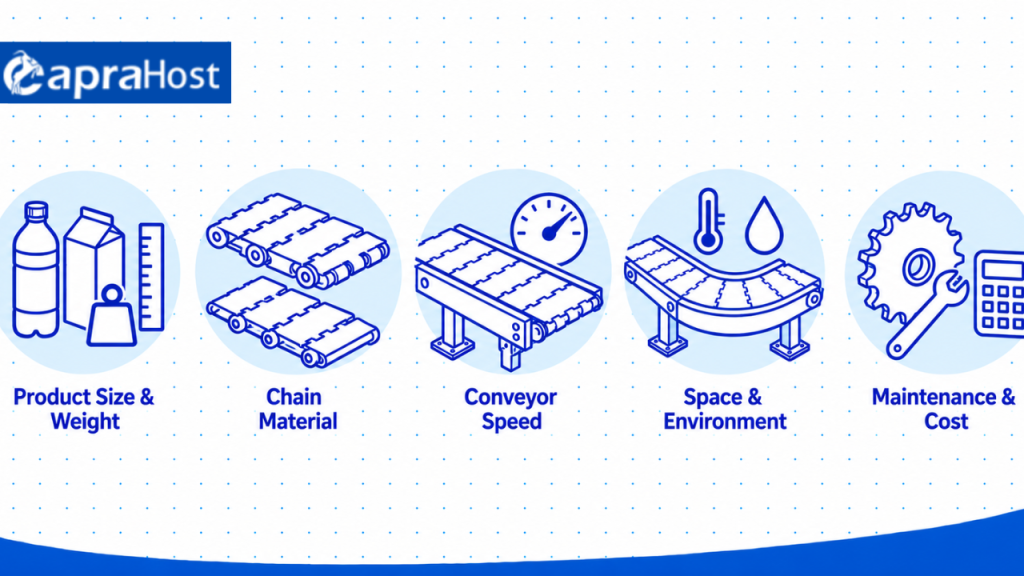
- Consider Product Size, Shape, and Weight: Measure the dimensions and weight of each product type. For example, tall glass bottles need adequate support and correctly positioned guide rails. Check the chain width and load ratings against the intended products.
- Choose the Appropriate Chain Material: Plastic chains like POM can suit certain container-handling applications. Stainless steel may offer better corrosion resistance in wet processing environments. Carbon steel can serve suitable dry applications with controlled corrosion exposure.
- Match Conveyor Speed to Production Requirements: Conveyor speed should work with connected equipment like fillers, cappers, and labelers. A line producing 120 bottles per minute must maintain suitable spacing and transfer flow. Increasing chain speed alone does not guarantee higher production output.
- Evaluate Available Space and Operating Conditions: Measure the available floor space and identify required curves or elevation changes. Consider temperature, moisture, cleaning chemicals, and product accumulation. Side-flexing chains may simplify curved layouts when their operating limits are respected.
- Consider Maintenance Needs and Overall Cost: Evaluate purchase price alongside energy use, replacement parts, and maintenance access. Check whether components like chains, sprockets, and wear strips are readily available. A suitable system should allow safe cleaning, inspection, and repair.
Flat Top Conveyor Maintenance and Common Problems
Flat top conveyor maintenance focuses on cleaning, component inspection, and replacing damaged parts. These activities help reduce unexpected downtime and product handling problems. Maintenance frequency should follow the manufacturer’s instructions and actual operating conditions.
Basic Maintenance Practices
- Cleaning and Routine Inspection: Remove accumulated debris and product residue from accessible conveying surfaces. Check guide rails, transfer points, and return paths for damage or obstruction. Before maintenance, isolate and lock out energy sources using approved procedures.
- Checking Chain, Sprockets, and Wear Strips: Inspect chain links for cracks, damage, or unusual wear. Examine sprocket teeth and wear strips for uneven contact or deterioration. Check bearings and shaft alignment using the manufacturer’s inspection guidance.
- Replacing Worn or Damaged Components: Replace damaged chain links and other affected components with compatible parts. Inspect adjoining parts for related wear before restarting operation. Follow the manufacturer’s procedures for chain installation, alignment, and tension.
Common Problems and Solutions
Three common conveyor problems are product jamming, excessive chain wear, and unusual operating noise. Each problem can have more than one cause. Correct diagnosis is necessary before replacing components or changing operating settings.
- Product Jamming or Tipping: Bottles may tip because of poor guide alignment or uneven transfer surfaces. Excessive accumulation pressure can also contribute to product instability. Inspect guides, product spacing, transfer gaps, and speed coordination.
- Excessive Chain Wear: Chain wear may increase because of misalignment, friction, or unsuitable operating conditions. Worn sprockets and damaged wear strips can worsen the problem. Inspect the complete chain path and follow approved lubrication guidance where applicable.
- Unusual Noise or Misalignment: Rattling or squealing may indicate component wear, interference, or excessive friction. Incorrect curve geometry can also contribute to noise in side-flexing systems. Stop the conveyor safely and inspect the affected components before resuming production.
The Habasit HabaCHAIN Engineering Guide provides technical guidance on plastic chain design and troubleshooting. Such guidance helps identify problems related to friction, chain movement, and conveyor construction. Always apply the instructions for the actual installed system.
What Affects the Cost of a Flat Top Conveyor?
The cost of a flat top conveyor depends mainly on dimensions, materials, customization, and long-term operating requirements. A standard straight conveyor may require less engineering than a customized curved system. However, actual pricing depends on the manufacturer’s design and quotation.
- Conveyor Dimensions and Chain Materials: Longer conveying paths generally need more chain, frame material, and supporting components. Chain materials like plastic, carbon steel, and stainless steel have different purchase and maintenance characteristics. Conveyor width and load requirements also affect equipment design.
- Customization and Automation Requirements: Curved paths, multiple lanes, and elevation changes may increase equipment complexity. Sensors, motor controls, and integration with packaging machines add further requirements. Installation and commissioning should also be considered when comparing quotations.
- Maintenance Costs and Long-Term Value: Operating expenses include electricity, cleaning, inspections, and component replacement. Chain wear, downtime, and spare-part availability influence lifetime costs. A lower initial price does not necessarily produce the lowest total ownership cost.
Total cost of ownership includes purchase, installation, operation, maintenance, and eventual replacement expenses. Compare quotations using the same production requirements and operating conditions. This provides a more useful basis for selecting equipment than purchase price alone.
Frequently Asked Questions About Flat Top Conveyors
Can a flat top conveyor move products around corners?
Yes, a flat top conveyor can move products around corners when equipped with a suitable side-flexing chain. These chains support curved layouts such as L-shaped and U-shaped paths. The minimum turning radius depends on the conveyor design and manufacturer specifications.
Are flat top conveyors suitable for heavy loads?
Some flat top conveyors can handle heavy loads when designed with suitable chains and drive components. Load capacity depends on chain strength, product weight, conveyor length, and operating conditions. Check the rated capacity before using the equipment for heavy products.
How long does a flat top conveyor chain last?
Flat top conveyor chain lifespan depends on operating load, friction, material, and maintenance practices. Excessive wear, poor alignment, and unsuitable cleaning conditions can shorten service life. Regular inspection helps determine when replacement is necessary.
Can flat top conveyors operate in wet environments?
Yes, properly designed flat top conveyors can operate in wet environments. Suitable stainless steel and selected plastic materials can provide corrosion resistance. The complete system must also have compatible motors, bearings, and cleaning procedures.
What is the difference between a flat top conveyor and a slat conveyor?
A flat top conveyor generally uses closely connected chain links to create a continuous carrying surface. A slat conveyor commonly uses rigid slats attached to supporting chains. Terminology can overlap, so compare actual construction rather than relying only on product names.
Conclusion
A flat top conveyor provides continuous product movement through a linked, motor-driven carrying surface. The seven essential considerations are its working principle, components, types, applications, benefits, specifications, and overall suitability. Understanding these factors helps prevent mismatches between equipment and production requirements.
Before choosing a system, review product dimensions, chain material, speed, load capacity, and layout. Consider maintenance access, operating conditions, and lifetime expenses alongside the initial purchase price. Always confirm the final design and technical limits using the manufacturer’s specifications.