
 Continue With Google
 continue with facebook




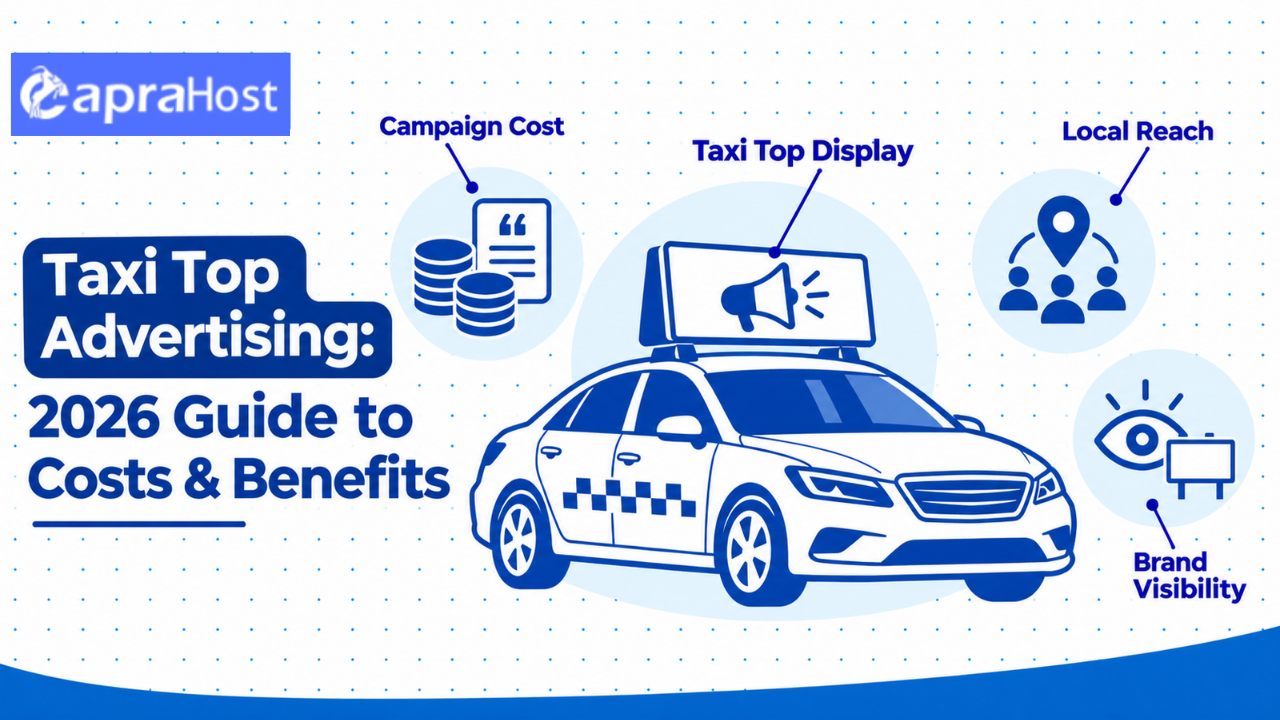
Taxi top advertising is a form of outdoor advertising that displays brand messages on taxi rooftops. These advertisements use printed signs or digital screens to reach people on busy streets. As taxis move through different areas, they create opportunities for brands to reach new audiences.
Businesses use taxi rooftop advertising to increase visibility, promote products, and reach potential customers. Unlike traditional billboards, taxi top advertisements move between locations instead of remaining in one place. Their effectiveness depends on factors such as location, campaign duration, advertising design, and budget.
This guide explains how taxi top advertising works, its main types, benefits, and costs in 2026. You’ll learn about audience targeting, advertising effectiveness, and potential disadvantages. We’ll also cover campaign planning, design practices, and methods for measuring advertising results.
What Is Taxi Top Advertising?
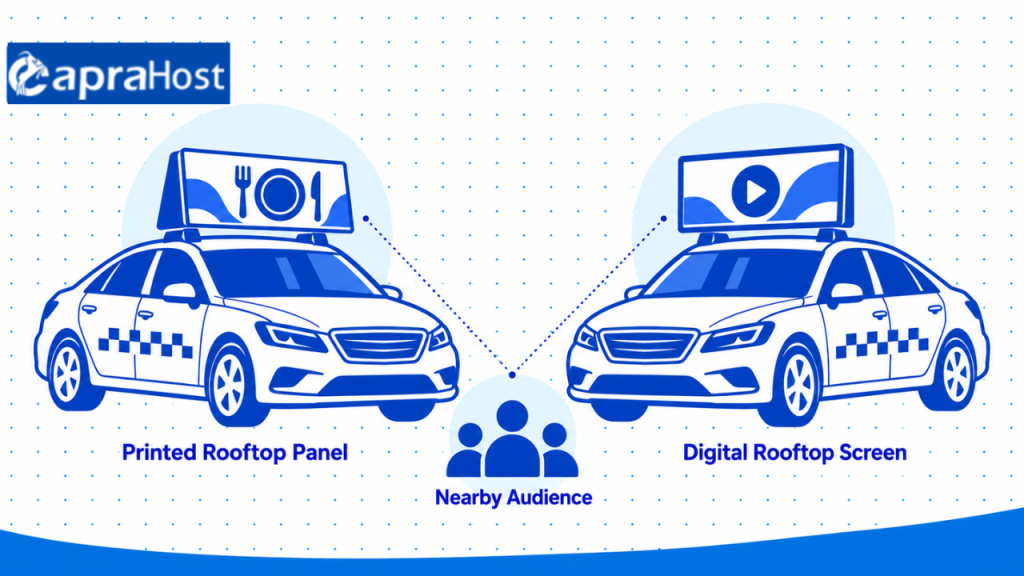
Taxi top advertising is an out-of-home advertising method that places promotional displays on taxi roofs. These displays feature printed advertising panels or electronic screens showing brand messages. They are primarily visible to pedestrians, motorists, and passengers traveling in nearby vehicles.
Taxi top advertising belongs to the broader out-of-home (OOH) advertising industry. OOH includes advertising formats such as roadside billboards, bus shelter advertisements, and transit displays. Digital taxi rooftop screens also belong to digital out-of-home advertising, commonly called DOOH.
According to the Out of Home Advertising Association of America (OAAA), U.S. OOH advertising revenue reached $9.46 billion in 2025. This represented 3.6% growth compared with the previous year. However, these figures represent the entire OOH industry, not taxi rooftop advertising alone.
For example, a restaurant could display its logo and promotional message on a taxi roof. People near shopping centers, intersections, and office buildings might encounter the advertisement during their daily travels. This creates advertising opportunities beyond one fixed location.
How Does Taxi Top Advertising Work?
Taxi top advertising works by mounting advertisements on taxi roofs and displaying them as participating vehicles travel. Advertising providers arrange the placement, coordinate with fleet operators, and manage campaign delivery. The advertiser selects a format, campaign duration, and geographic coverage.
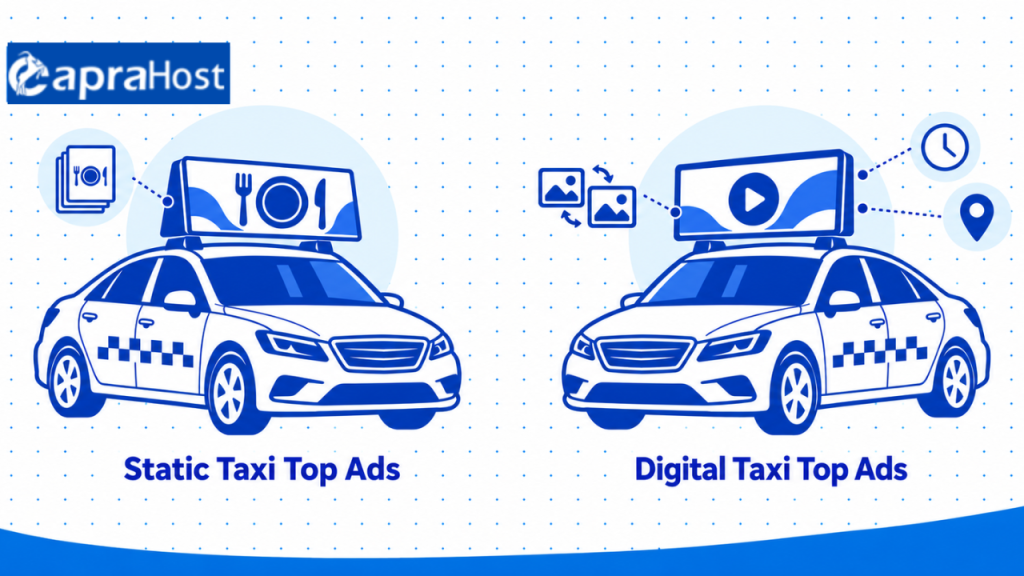
Static taxi top advertisements use printed panels, often housed inside illuminated rooftop units. They normally display one advertiser’s message throughout the purchased placement period. Changing the design usually requires printing and installing new artwork.
Digital taxi tops use electronic screens to rotate advertisements according to programmed schedules. One screen can display messages from several advertisers during different time slots. Supported networks may also change content according to vehicle location or time of day.
The advertisements reach people when participating taxis pass through areas such as shopping streets, airports, and business districts. Actual exposure depends on taxi activity, traffic conditions, screen visibility, and the advertising schedule. A taxi traveling near a shopping center does not guarantee every nearby person will notice its advertisement.
Advertising space is commonly purchased through a media owner, advertising agency, or outdoor advertising marketplace. Static placements are frequently quoted by vehicle and four-week period. Digital campaigns may use screen-time allocations, estimated impressions, or other provider-specific buying arrangements.
Before purchasing, advertisers should confirm exactly what their agreement includes. Important details include fleet size, expected coverage, advertising frequency, and maintenance responsibilities. These terms determine what the advertiser receives and how campaign delivery can be checked.
Types of Taxi Top Advertising
The two main types of taxi top advertising are static rooftop advertisements and digital rooftop displays. Both place advertising above the vehicle, but their delivery methods differ. The best format depends on creative requirements, campaign objectives, and available inventory.
Static Taxi Top Advertising
Static taxi top advertising uses printed advertising panels mounted inside a rooftop display. Some displays include internal lighting to improve visibility after sunset. The advertisement normally remains unchanged throughout the booking period.
According to AdQuick’s taxi advertising guide, a common static rooftop format measures approximately 14 × 48 inches. Exact dimensions depend on the equipment and advertising provider. Advertisers should request the correct artwork template before designing their advertisement.
Static advertising suits a business promoting one consistent message over several weeks. For example, a bakery could display its business name, logo, and website throughout a four-week campaign. This approach avoids repeated creative changes and maintains a consistent brand appearance.
Digital Taxi Top Advertising
Digital taxi top advertising uses electronic screens to display changing promotional messages. These screens commonly use LED technology and software-controlled advertising schedules. Depending on the provider, advertisers can update content without replacing physical printed panels.
Digital displays may support dayparting, geofencing, and location-triggered advertising. Dayparting means scheduling advertisements for selected periods, such as breakfast or evening commuting hours. Geofencing allows supported systems to activate specific messages when a vehicle enters a defined area.
For example, a restaurant could display a breakfast promotion before 10 a.m. The same screen could promote dinner reservations after 5 p.m. Such scheduling requires compatible technology and an agreement allowing those creative changes.
Static vs. Digital Taxi Top Ads
Static taxi tops provide consistent advertising, while digital taxi tops offer greater scheduling and creative flexibility. Static signs usually give one advertiser continuous use of the purchased display surface. Digital screens may divide available advertising time between several advertisers.
| Feature | Static Taxi Top Ads | Digital Taxi Top Ads |
| Display | Printed panel | Electronic screen |
| Creative changes | Physical replacement | Software updates |
| Night visibility | With suitable illumination | With operating screen |
| Advertising rotation | Usually one fixed message | Multiple scheduled messages |
| Location targeting | Mainly fleet selection | May support GPS triggers |
| Production | Printing and installation | Digital artwork preparation |
| Best use | Consistent brand awareness | Changing promotions and campaigns |
A static advertisement may suit an established company promoting its name throughout a campaign. Digital advertising may suit a retailer advertising different offers throughout the day. Neither format automatically guarantees higher reach or better financial returns.
What Are the Benefits of Taxi Top Advertising?
Taxi top advertising offers five main advantages: mobile reach, street-level visibility, nighttime exposure, repeated awareness, and campaign flexibility. These advantages make it relevant for businesses targeting people traveling through urban areas. Their actual value depends on campaign planning and local taxi activity.
- High visibility in busy areas. Rooftop placement positions advertisements above the vehicle body, where nearby pedestrians and motorists may notice them. Suitable environments include shopping districts, downtown streets, and intersections with regular traffic.
- Mobile reach across locations. Unlike fixed billboards, taxi top advertisements move as participating vehicles travel. One advertisement may appear near offices, retail centers, and entertainment venues during the same campaign.
- Daytime and nighttime exposure. Printed advertisements can be visible during daylight, while illuminated displays support visibility after sunset. Actual nighttime delivery depends on vehicle operation, lighting conditions, and screen availability.
- Repeated brand exposure. Repeated encounters may help audiences recognize a business name, logo, or promotional message. However, frequency depends on vehicle movement, audience routines, and campaign coverage rather than being guaranteed.
- Flexible advertising options. Static displays support consistent messaging, while digital displays can accommodate time-sensitive promotions. A retailer could advertise a seasonal sale, change the offer, or schedule different messages through the day.
These benefits make taxi rooftop advertising particularly relevant for awareness-focused campaigns. However, exposure alone does not prove that someone remembered the advertisement or purchased a product. Advertisers should match these potential advantages with clear performance goals.
How Much Does Taxi Top Advertising Cost?
Taxi top advertising can cost approximately 100–1,000 per vehicle for four weeks, based on published U.S. provider estimates. This broad range combines different pricing sources and advertising formats. Actual quotations vary according to location, fleet size, availability, and campaign requirements.
Static vs. Digital Taxi Top Advertising Costs
Static and digital taxi top advertisements use different production methods and may have different buying arrangements. Static campaigns commonly involve physical signage and installation expenses. Digital campaigns may charge for scheduled advertising time rather than exclusive access to the screen.
Published estimates from AdQuick and Alluvit Media illustrate the variation in advertised rates. Both sources provide approximate four-week per-vehicle pricing. Their figures should be treated as provider estimates rather than universal market prices.
| Advertising type | AdQuick estimate | Alluvit Media estimate |
| Static taxi top | 100–500 | 500–1,000 |
| Digital taxi top | 120–800 | 300–800 |
| Billing period | Per vehicle / 4 weeks | Per taxi / 4 weeks |
These estimates do not establish identical screen-time commitments, geographic coverage, or production inclusions. An inexpensive digital placement may involve limited advertising rotation compared with another package. Always request a written quotation describing the actual purchased inventory.
Factors That Affect Advertising Costs
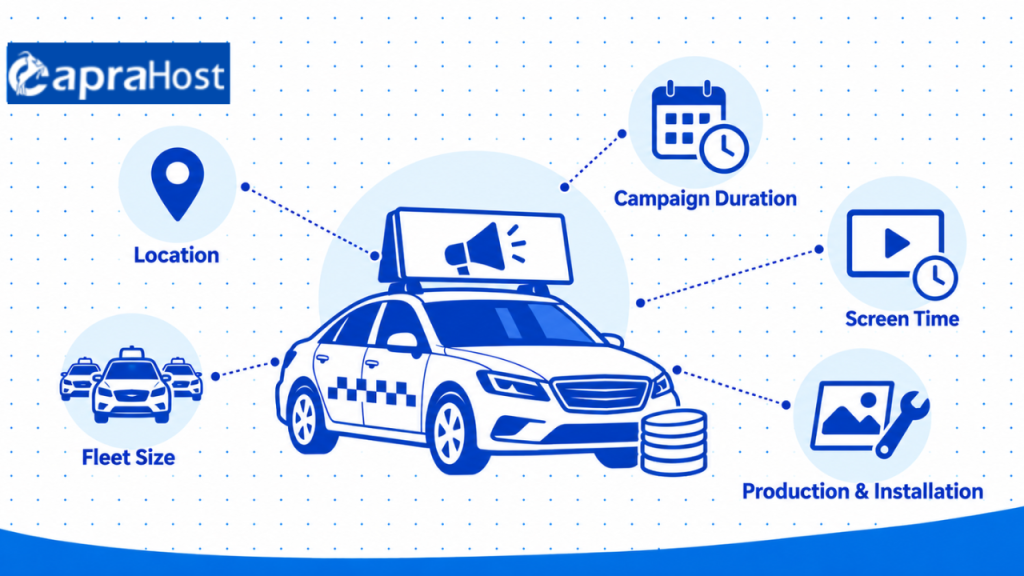
Five main factors influence taxi top advertising prices: location, fleet size, campaign duration, production, and display allocation. Understanding these factors helps advertisers compare quotations fairly. The lowest per-vehicle price does not necessarily deliver the best audience coverage.
- Market and location: Advertising demand and taxi availability affect local pricing.
- Fleet size: A larger fleet increases total spending but may qualify for volume discounts.
- Campaign duration: Longer commitments may reduce the effective weekly price.
- Production and installation: Static advertisements may require artwork preparation, printing, and installation fees.
- Screen time: Digital campaigns may charge according to advertising frequency or share of voice.
Share of voice describes the percentage of available advertising time allocated to one advertiser. For example, a 20% share represents one-fifth of the relevant screen inventory. Advertisers should confirm whether that percentage applies across every participating display or only selected periods.
How to Estimate Your Campaign Budget
Calculate your campaign budget by combining advertising placement fees with production and installation costs. A simple hypothetical example can illustrate the process. These figures are assumptions and do not represent a confirmed vendor quotation.
| Campaign expense | Calculation | Estimated cost |
| Static rooftop placements | 10 taxis × $400 | $4,000 |
| Artwork and printing | Assumed fee | $500 |
| Installation | Assumed fee | $300 |
| Total | $4,800 |
The hypothetical campaign costs $4,800 for four weeks, including its assumed preparation fees. Advertising buyers can also calculate cost per thousand impressions, usually called CPM. This metric helps compare the estimated exposure cost of different campaigns.
CPM = (Total campaign cost ÷ Estimated impressions) × 1,000
For example, assume the $4,800 campaign generates 800,000 modeled advertising impressions. Dividing $4,800 by 800,000 and multiplying by 1,000 produces a $6 CPM. This calculation represents estimated exposure costs, not verified attention, customer visits, or sales.
Before booking, request written information about cancellation terms and any additional fees. Ask whether screen downtime, damaged signs, or unavailable vehicles qualify for replacement advertising. Clear commercial terms reduce the risk of paying for undelivered placements.
How Effective Is Taxi Top Advertising?
Taxi top advertising can support brand awareness and customer interest, but its effectiveness must be evaluated against campaign objectives. Results depend on audience exposure, message clarity, geographic coverage, and repetition. Advertisers should measure both delivery and meaningful business outcomes.
A 2024 OAAA and Harris Poll study found that 76% of recent DOOH viewers reported taking action after seeing digital outdoor advertising. This was a consumer survey covering the broader DOOH category. It does not establish a 76% action rate for taxi top advertising specifically.
Three important advertising metrics help explain campaign delivery. Impressions estimate total opportunities for advertisement exposure. Reach estimates unique audience members, while frequency estimates how often those people encounter the advertisement.
For example, assume a campaign produces 100,000 estimated impressions among 40,000 unique people. Its average frequency would equal 2.5 estimated exposures per person. These hypothetical figures explain the calculation without claiming actual campaign performance.
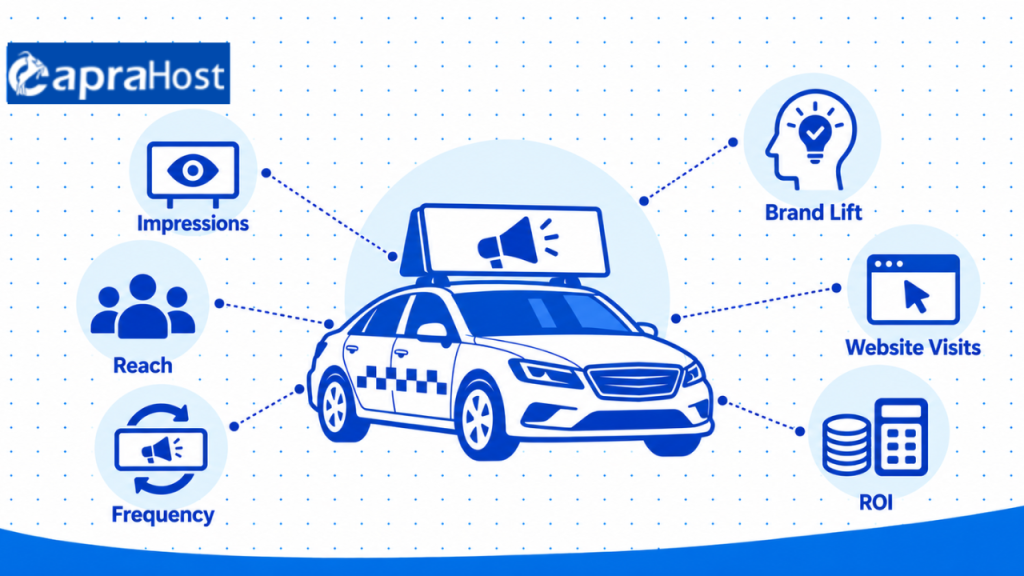
Advertising companies may estimate exposure using GPS movement records, traffic information, and audience models. These methods help estimate where advertisements appeared and how many people might have encountered them. However, an estimated impression cannot prove that someone looked at or remembered the message.
Brand lift measures changes in awareness, recall, or consideration among a target audience. Advertisers can use surveys before and after a campaign to evaluate these changes. More rigorous studies compare appropriately matched exposed and unexposed audience groups.
Website visits, branded searches, and promotional code redemptions can provide additional performance signals. A unique landing page or discount code may help connect customer responses with a campaign. However, other advertising activity and seasonal demand can influence these results.
Return on investment (ROI) measures financial gains relative to advertising costs. For example, a $5,000 campaign producing $7,000 in attributable gross profit generates a 40% ROI. The calculation assumes the $7,000 profit is genuinely attributable to the advertising.
Campaign reporting should distinguish modeled impressions from verified ad playback and measurable business outcomes. Digital playback records can show that an advertisement was scheduled or displayed, but not that every person noticed it. This distinction prevents advertisers from confusing advertising delivery with proven effectiveness.
How Does Taxi Top Advertising Reach the Right Audience?
Taxi top advertising reaches selected audiences through geographic coverage, vehicle movement, and optional digital targeting technology. Rooftop advertisements primarily reach pedestrians and occupants of nearby vehicles. Their audience depends on where participating taxis travel during the campaign.
Geographic targeting begins with selecting suitable markets and fleet coverage. Advertisers may prioritize commercial districts, shopping centers, airport corridors, or entertainment areas. However, most taxis follow passenger demand rather than advertiser-controlled fixed routes.
Digital networks may provide more precise scheduling through GPS tracking and geofencing. GPS records vehicle location, while geofencing defines a geographic area for location-triggered messaging. These features require compatible equipment and provider support.
Dayparting allows advertisers to schedule messages during selected periods. For example, a café could promote breakfast between 7 a.m. and 10 a.m. A restaurant could instead advertise evening dining offers after 5 p.m.
Location-based creative can also connect an advertisement to the surrounding area. A retailer might promote a nearby store when a participating taxi enters the relevant advertising zone. Actual delivery still depends on vehicle availability, screen operation, and the campaign’s scheduled inventory.
Advertisers should request coverage maps, operating-hour estimates, and targeting specifications before purchasing. These details clarify the difference between potential geographic reach and delivered advertising. Precise GPS coordinates alone do not guarantee that the intended audience saw the message.
Taxi Top Advertising vs. Other Outdoor Advertising
Taxi top advertising differs from billboards, taxi wraps, and bus ads in mobility, display space, coverage, and creative flexibility. Each format serves different communication needs and audience environments. Choosing one requires comparing campaign goals rather than assuming one format always performs better.
Taxi Top Advertising vs. Traditional Billboards
Taxi top ads move between locations, while traditional billboards remain at fixed sites. This allows rooftop advertisements to reach people along changing taxi routes. Billboards instead provide consistent placement at selected roads, intersections, or commercial areas.
Traditional billboards generally offer more advertising space for large graphics and longer viewing distances. Taxi top displays are smaller and require shorter, more readable messages. Neither format guarantees that every passing person will notice the advertisement.
A fixed billboard may suit a retailer targeting motorists near one shopping destination. Taxi top advertising may suit a business seeking coverage across several commercial districts. The better option depends on geographic goals, expected impressions, and comparable campaign costs.
Taxi Top Advertising vs. Taxi Wraps and Bus Ads
Taxi top ads use rooftop displays, taxi wraps cover vehicle body panels, and bus ads occupy transit advertising surfaces. Taxi wraps can accommodate larger graphics than rooftop signs. Bus advertising may offer predictable route coverage where buses follow published routes.
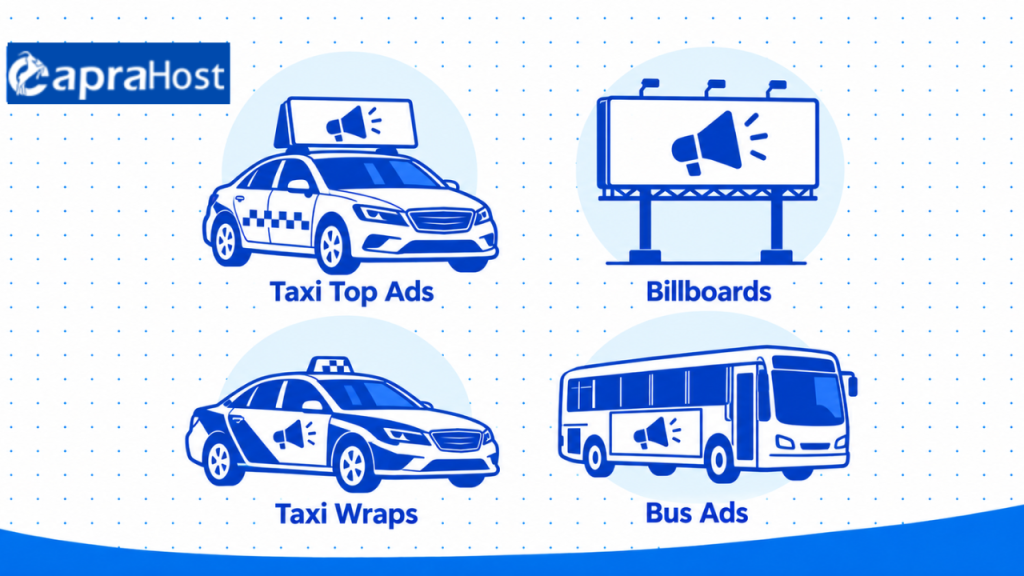
| Feature | Taxi Top Ads | Taxi Wraps | Bus Ads |
| Placement | Rooftop | Vehicle body | Bus sides or rear |
| Advertising space | Small | Medium to large | Often larger |
| Movement | Taxi operating areas | Taxi operating areas | Usually scheduled routes |
| Digital availability | On equipped vehicles | Usually static graphics | Depends on network |
| Creative changes | Flexible with digital | Physical replacement | Format-dependent |
| Common use | Short brand messages | Large visual branding | Repeated route exposure |
For example, a restaurant might choose a taxi top for a short promotional message. A product launch could use a full vehicle wrap for greater visual space. A business targeting one transport corridor might consider bus advertising instead.
What Are the Disadvantages of Taxi Top Advertising?
Taxi top advertising has six notable limitations: restricted space, brief viewing time, route uncertainty, equipment issues, regulatory requirements, and measurement challenges. Understanding these problems helps advertisers set realistic expectations. Some limitations can be reduced through better planning, but none should be ignored.
Limited display space restricts the amount of information an advertiser can include. Rooftop signs cannot comfortably display long descriptions, detailed pricing lists, or complex instructions. Short headlines and recognizable branding are therefore more suitable.
Brief viewing time can make advertisements difficult to read. Pedestrians and motorists may encounter a moving rooftop message for only seconds. Small text, weak contrast, and complicated artwork increase the risk of missed communication.
Unpredictable taxi routes can produce uneven geographic coverage. Passenger demand, traffic congestion, and driver schedules influence where vehicles operate. Advertisers should avoid assuming that every participating taxi will visit every preferred location.
Technical issues can affect digital campaign delivery. Equipment may experience display failures, power interruptions, or network connectivity problems. Advertisers should ask providers how downtime is monitored and whether missed advertising receives replacement delivery.
Advertising regulations vary by jurisdiction and vehicle category. Rules may address rooftop installations, lighting brightness, equipment safety, or advertisement content. Providers should confirm applicable permissions and operating requirements before the campaign launches.
Measurement limitations make it difficult to confirm individual attention. GPS-based estimates can model exposure opportunities but cannot prove that every person noticed the display. Advertisers should evaluate reported results using clearly defined methods and assumptions.
How to Design an Effective Taxi Top Advertisement
An effective taxi top advertisement communicates one clear message using readable text, contrasting colors, and recognizable branding. People often view rooftop advertisements from moving or nearby vehicles. The design should therefore make its main point understandable within a brief viewing period.
Keep advertising messages short and focused. A practical starting point is one main headline containing approximately seven words or fewer. For example, a coffee shop might use the message “Fresh Coffee. Every Morning.”
Choose fonts that remain readable from a distance. Bold, simple typefaces usually communicate more clearly than decorative lettering. Strong contrast, such as black on yellow or white on dark blue, improves text separation.
Make the business identity recognizable. Place the company name or logo where it can be noticed quickly. Consistent colors and typography can help connect the rooftop message with other brand advertising.
Include one practical call to action when appropriate. A short website address, memorable phrase, or simple instruction can guide interested viewers. Long URLs and detailed QR codes may be difficult to use safely from moving traffic.
Avoid crowded designs and competing messages. Too many visual elements make it harder to identify the main offer. One readable headline and one strong brand identifier are often more useful than several promotional claims.
Before approval, test the artwork at its actual display proportions. Review it from a realistic viewing distance and check daytime contrast. Request the provider’s exact file specifications, safe areas, and brightness requirements for the purchased display.
How to Start a Taxi Top Advertising Campaign
Starting a taxi top advertising campaign involves six stages, from goal-setting to performance evaluation. Each stage should support one clearly defined advertising objective. A documented plan helps advertisers compare providers and understand campaign delivery.
- Define your advertising goal and audience. Decide whether the main objective is brand awareness, event attendance, website traffic, or store visits. Identify likely customers, such as office commuters, retail shoppers, or tourists.
- Choose static or digital advertising. Static signs suit a consistent message that will not need regular changes. Digital displays may suit promotions requiring scheduled creative updates or location-triggered content.
- Establish a budget and campaign duration. Include placement charges, creative production, installation, and measurement costs. For example, 10 taxis priced at $400 each would require $4,000 in placement fees for one four-week period.
- Evaluate advertising providers and fleet coverage. Compare quotations based on inventory, estimated reach, campaign timing, and reporting methods. Ask whether the agreement guarantees vehicles, screen time, ad plays, or modeled impressions.
- Prepare and approve the advertisement. Use the provider’s required dimensions, file formats, and approval procedures. Confirm that the design follows applicable advertising and vehicle-display requirements.
- Launch, monitor, and evaluate delivery. Request installation confirmation for static signs or playback reporting for digital advertisements. Compare actual delivery reports and available customer-response data against the campaign’s original goals.
According to AdQuick, some digital taxi advertising campaigns can launch in as little as 48 hours. The provider also describes longer preparation periods for printed placements. These represent provider-specific capabilities rather than guaranteed industry-wide timelines.
Before signing, review the agreement’s cancellation terms, reporting commitments, and treatment of unavailable displays. Confirm whether artwork changes or replacement installations create additional fees. A written agreement should clearly describe both the purchased service and expected deliverables.
Which Businesses Benefit Most From Taxi Top Advertising?
Taxi top advertising is particularly relevant for businesses seeking visibility among urban consumers and people traveling through commercial areas. Common examples include restaurants, retail brands, entertainment businesses, and hospitality providers. Campaign suitability depends on audience location, advertising goals, and available budget.
Restaurants and retail businesses can promote products, opening announcements, or seasonal offers. A café might advertise near office districts, while a clothing retailer could focus on shopping areas. These campaigns benefit when the selected fleet regularly operates near potential customers.
Entertainment companies and event organizers can use rooftop advertising to build awareness before scheduled activities. Examples include concert announcements, cinema releases, and festival promotions. Digital content may be useful when dates, offers, or promotional messages need updating.
Hotels and tourism businesses can advertise near locations used by visitors. Examples include airport corridors, sightseeing districts, and transport hubs. A hotel campaign could prioritize brand recognition and a short booking message.
Real estate and service providers can promote offerings across relevant urban markets. Examples include apartment developments, healthcare clinics, and professional services. The advertising message should match the service area and intended audience.
Small businesses may consider rooftop advertising when their customers regularly travel through available fleet coverage areas. However, a large minimum booking could make the format unsuitable for a limited marketing budget. Advertisers should compare expected exposure and costs with other available marketing channels.
Consider a hypothetical restaurant launching a four-week campaign using 10 static taxi tops. At $400 per vehicle, the placement cost would be $4,000 before additional production expenses. The restaurant could promote one memorable offer and use a unique discount code to help track customer responses.
The code would provide information about recorded promotional redemptions. However, it would not capture every customer influenced by the advertising. This illustrates why campaign performance should be evaluated using more than one measurement method.
Frequently Asked Questions About Taxi Top Advertising
Is Taxi Top Advertising Worth It for Small Businesses?
Taxi top advertising may be worthwhile for small businesses targeting customers in areas with regular taxi activity. The value depends on campaign cost, relevant geographic exposure, and business objectives. Small advertisers should compare the full quotation with other available marketing options before committing.
How Long Should a Taxi Top Advertising Campaign Run?
Campaign duration depends on the advertising objective, budget, and expected exposure frequency. A four-week campaign may suit a scheduled promotion, while longer campaigns may support repeated brand exposure. There is no universal minimum duration that guarantees measurable results.
Can Digital Taxi Top Ads Change Based on Location or Time?
Yes, compatible digital taxi top networks can change advertising according to location or scheduled time periods. GPS-based triggers may activate selected messages inside defined geographic zones. Advertisers must confirm that the provider supports these features and includes them in the agreement.
Are Taxi Top Advertisements Visible at Night?
Taxi top advertisements can remain visible at night when they use suitable lighting or functioning digital screens. Static rooftop signs may use internal illumination, while digital units produce their own light. Actual visibility depends on operating hours, equipment performance, environmental conditions, and local lighting rules.
Do Taxi Top Advertisements Require Special Permits?
Taxi top advertising permissions depend on local vehicle and advertising regulations. Some jurisdictions regulate equipment mounting, display brightness, and permitted advertising content. Advertisers should confirm compliance responsibilities with the provider and relevant authorities before installation.
Final Thoughts on Taxi Top Advertising
Taxi top advertising offers a mobile outdoor advertising option for businesses seeking visibility across urban areas. Static rooftop signs support consistent messaging, while digital displays provide greater scheduling and creative flexibility. Both formats require careful consideration of coverage, costs, and expected exposure.
An effective campaign begins with clear goals, relevant fleet selection, and readable advertising artwork. Advertisers should also evaluate limitations such as route variability, equipment reliability, and measurement uncertainty. Comparing written quotations and performance methods helps establish realistic expectations.
The best taxi top advertising strategy is one that matches the business audience, budget, and measurable campaign objectives. Before investing, confirm what advertising inventory is being purchased and how delivery will be reported. This approach makes it easier to judge whether rooftop advertising fits the wider marketing plan.